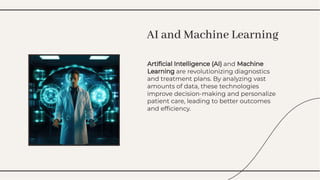
The Impact of Artificial Intelligence on Modern Healthcare
Artificial intelligence (AI) is revolutionizing the healthcare industry, leading to groundbreaking advancements that promise to enhance patient outcomes and streamline medical processes. From diagnostic tools leveraging machine learning algorithms to personalized medicine based on big data analytics, AI is at the forefront of a transformative wave in healthcare.
Transformative AI Technologies in Healthcare
Diagnostic Tools
One of the most significant contributions of AI in healthcare is its ability to assist in early disease detection. AI-driven diagnostic tools are being deployed to analyze medical imagery and patient data with remarkable accuracy, often surpassing human capabilities. For instance, AI algorithms are now routinely employed to detect anomalies in X-rays and MRIs, identifying conditions such as tumors and fractures with high precision. This not only speeds up the diagnosis process but also reduces the likelihood of human error, a critical factor in patient care.
Personalized Medicine
AI's role in personalized medicine marks a pivotal shift towards more tailored healthcare solutions. By analyzing vast datasets from genetic information to lifestyle factors, AI can predict how individual patients might respond to certain treatments. This enables healthcare providers to craft personalized treatment plans that maximize efficacy and minimize adverse effects. According to Scientific American, this bespoke approach is set to redefine treatment protocols and improve patient outcomes significantly.
Recent Developments and Innovations
AI in Telemedicine
Telemedicine, which gained popularity during the COVID-19 pandemic, continues to benefit from AI advancements. AI-powered platforms are facilitating remote consultations by interpreting patient symptoms and offering preliminary diagnoses. This not only increases accessibility for patients in remote areas but also alleviates the burden on healthcare facilities by reducing the need for in-person visits.
Robotics in Surgery
Robotic surgery is another area where AI is making waves. Surgical robots, equipped with AI capabilities, assist surgeons in performing complex procedures with enhanced precision and control. These robots are particularly beneficial in minimally invasive surgeries, where precision is paramount. The use of AI in robotics ensures better outcomes, shorter recovery times, and reduced risk of complications.

Benefits of AI in Healthcare
Improved Efficiency
AI technologies are streamlining operations in healthcare facilities by automating routine tasks. This includes everything from scheduling appointments to managing electronic health records. By reducing the administrative burden on healthcare providers, AI allows them to focus more on patient care, thus improving overall efficiency within healthcare systems.
Enhanced Data Analysis
AI's ability to analyze large volumes of data quickly and accurately is transforming research in healthcare. By identifying patterns and correlations within complex datasets, AI is aiding researchers in uncovering new insights into diseases and potential treatments. This accelerates the pace of medical research and propels the development of innovative treatments.
Challenges and Ethical Considerations
While AI holds immense promise for healthcare, it also presents several challenges and ethical considerations.
Data Privacy
The integration of AI in healthcare relies heavily on access to vast amounts of patient data. Ensuring the privacy and security of this data is crucial to maintaining patient trust and complying with regulations such as the Health Insurance Portability and Accountability Act (HIPAA). Organizations must implement robust data protection strategies to safeguard sensitive information.
Bias and Fairness
AI systems are only as good as the data they are trained on. Biased datasets can lead to skewed results, potentially exacerbating existing health disparities. It is imperative for developers to use diverse and representative datasets to train AI models, ensuring fairness and equity in healthcare delivery.
Accountability and Transparency
The use of AI in clinical decision-making raises questions about accountability. In instances where AI systems are involved in patient care, it is crucial to establish clear guidelines regarding responsibility and liability. Moreover, transparency in AI algorithms is necessary to ensure that healthcare providers and patients understand how decisions are made.
The Future of AI in Healthcare
The future of AI in healthcare is bright, with ongoing research and development promising to unlock new possibilities. AI's potential to revolutionize areas such as drug discovery, mental health, and chronic disease management is vast. As technology continues to evolve, it is essential for stakeholders to collaborate, ensuring that AI is harnessed ethically and effectively to improve healthcare outcomes globally.

In conclusion, artificial intelligence is set to become an indispensable tool in modern healthcare. Its ability to enhance diagnostic accuracy, personalize treatment plans, and improve operational efficiency underscores its transformative potential. As we navigate the challenges and harness the opportunities presented by AI, the healthcare industry stands on the brink of a new era, poised to deliver unprecedented benefits to patients worldwide.